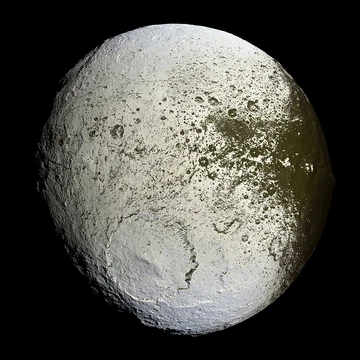
Cold spot (astronomy)
Cold spots are young impact features with low nighttime temperatures.

Wikipedia / Wikimedia Commons
A cold spot is an area of unusually low nighttime surface temperature that surrounds a fresh impact crater on a world without an atmosphere. On the Moon, these patches were first detected by the Apollo 17 mission, which carried an infrared radiometer. They were formally identified and mapped in 2011 by planetary scientist Joshua Bandfield and his team, using data from the Diviner Lunar Radiometer Experiment aboard NASA’s Lunar Reconnaissance Orbiter. Over 2,200 such spots have been found between 50° north and 50° south latitude, with source craters ranging from 43 meters to 2.3 kilometers in diameter. They cover more than 1% of the lunar surface.
The spots form when a hypervelocity impact displaces and loosens material. The ejected debris settles into a “fluffy” surface layer that is less densely packed than the surrounding regolith. This low-density material has lower thermal inertia, meaning it stores less heat and cools faster after sunset. On the Moon, these ray-like features extend 10 to 100 times the radius of the impact crater and are 2 to 10 Kelvin cooler than the surrounding surface. Over time—roughly 0.5 to 1 million years—successive impacts and seismic shaking recompact the material, and the cold spot fades to background levels.
The Apollo 17 command module, in lunar orbit during December 1972, carried an infrared scanning radiometer that first detected low-temperature anomalies near certain craters. Scientists Wendell Mendell and Frank Low reported these observations in 1974, but the findings drew little attention for decades. After the Lunar Reconnaissance Orbiter launched in June 2009, the Diviner instrument began a systematic global mapping campaign. It measured emitted thermal radiation and reflected sunlight, deriving surface temperatures to within 1–2 Kelvin. Using seven spectral channels spanning visible and infrared wavelengths, Diviner collected over 500 billion measurements and produced a map with a spatial resolution of 180 by 300 meters per pixel. Analysis of this dataset in 2011 by Bandfield and colleagues established cold spots as a distinct class of surface feature. They appear in nighttime temperature maps as ray-like or irregular patches of cooler ground radiating from a central young crater, but they are invisible in daytime maps and in visible or near-infrared reflectance data, showing no unusual brightness, color, or shape.
- first observed
- December 1972 (Apollo 17)
- characterized
- 2011 by Joshua Bandfield and collaborators
- typical temperature difference
- 2–10 Kelvin cooler than surroundings
- extent
- 10 to 100 times the radius of the source crater
- lifespan
- 0.5–1 million years
- number identified
- over 2,200 (between 50° N and 50° S)
- source crater size range
- 43 meters to 2.3 kilometers in diameter
Lore & Background
Cold spots were first detected by the infrared scanning radiometer aboard the Apollo 17 command and service module during lunar orbit in December 1972. Observations reported by Wendell W. Mendell and Frank J. Low in 1974 attracted little further investigation for several decades. The phenomenon was systematically characterized and mapped by planetary scientist Joshua Bandfield and collaborators in 2011 using data from the Diviner Lunar Radiometer Experiment on NASA's Lunar Reconnaissance Orbiter, which had launched in June 2009.
Cold spots appear in nighttime temperature maps as ray-like or irregular patches of suppressed temperature radiating outward from a central young crater. They are absent from daytime maps and visible or near-infrared reflectance data, with no distinguishing albedo, spectral, or geomorphology signature. Detection depends on nighttime thermal infrared mapping. Over 2,200 cold spots have been identified on the lunar surface between latitudes 50° N and 50° S, with source craters ranging from 43 meters to 2.3 kilometers in diameter.
The formation mechanism remains an active area of research, with three main hypotheses: granular flow and secondary impacts, an expanding vapor cloud, and seismic wave transmission. Cold spots are transient features that fade within roughly 0.5–1 million years as meteorite and micrometeorite bombardment recompacts the decompacted regolith layer. Secondary impacts are thought to be the dominant driver of this fading.
Reader's Guide
Cold spots are significant because they provide a practical tool for identifying impact craters formed within the last million years, constraining models for impact flux rate on the Moon. They also reveal the rate and depth at which the lunar surface is continuously turned over and mixed by meteorite bombardment. Their rapid degradation implies that the uppermost regolith is actively processed on geologically short timescales. Cold spots have been found only on the Moon but are predicted to be present on Mercury and other airless bodies. The phenomenon is universal to recent impacts above 40 meters in diameter, and the total volume of decompacted material in a cold spot is typically more than ten times the volume of the source crater itself, suggesting modification far beyond direct ejecta deposition.
Did You Know?
- Cold spots cover over 1% of the lunar surface.
- The largest cold spot catalogued, associated with a 1.1 km crater, covers approximately 2,070 square kilometers.
- Cold spots have thermal inertia values 10 to 30 percent lower than the global average for lunar regolith fines.
- Analysis of Apollo 16 astronaut footprint depths found slightly deeper footprints in the cold spot surrounding South Ray crater, providing physical evidence for lower density regolith.
More in Impact craters 1-18
Spotted an error? Know more?
This is a living reference — every entry is fact-audited, and reader corrections feed straight into our audit queue. Suggest an edit · See this site's audit record