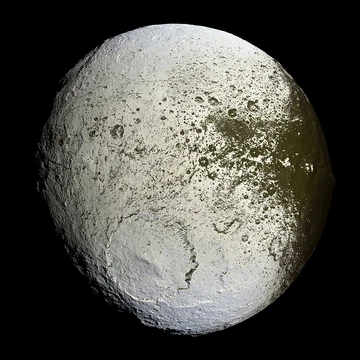
Complex crater
Large impact craters with uplifted centers and terraced walls.

Wikipedia / Wikimedia Commons
Complex craters are a type of large impact crater morphology that form above a certain threshold size, which varies with planetary gravity. They result from extensive collapse and modification of a transient cavity, driven by gravity, involving uplift of the central region and inward collapse of the rim. Complex craters are classified into two groups: central-peak craters and peak-ring craters.
- classification
- Central-peak craters and peak-ring craters
- minimum_diameter_on_Earth
- 2 to 4 kilometers
- minimum_diameter_on_Moon
- 20 kilometers
- lunar_central_peak_range
- 35 to 170 kilometers diameter
- transition_to_peak_ring_on_Moon
- about 175 kilometers diameter
- transition_to_impact_basin
- exceeds 300 kilometers diameter
Lore & Background
Complex craters have uplifted centers, broad flat shallow floors, and terraced walls. At the largest sizes, one or more exterior or interior rings may appear, and the structure may be labeled an impact basin. On rocky planets, complex-crater morphology follows a regular sequence with increasing size: small complex craters with a central topographic peak are called central-peak craters (e.g., Tycho); intermediate-sized craters, in which the central peak is replaced by a ring of peaks, are called peak ring craters (e.g., Schrödinger); and the largest craters contain multiple concentric topographic rings, called multi-ringed basins (e.g., Orientale). On icy bodies, other forms appear, such as central pits and many concentric rings—Valhalla on Callisto is the type example.
Reader's Guide
Complex craters represent a fundamental transition in impact crater morphology, driven by gravity rather than elastic rebound. Their formation involves the collapse of a transient cavity, with central uplift occurring as material with little or no strength attempts to return to gravitational equilibrium. The threshold diameter for complex craters varies inversely with planetary gravity: on Earth, complex craters appear at diameters as small as 2 to 4 kilometers, while on the Moon they begin at about 20 kilometers. Lunar craters between 35 and 170 kilometers typically possess a central peak, while those larger than about 175 kilometers develop ring-shaped uplifts. The height of central peaks on the Moon is directly proportional to crater diameter, implying a relationship with crater-forming energy. Complex craters are common on Earth, the Moon, Mars, and Mercury. Their study provides insight into planetary surface processes and the mechanics of large impacts.
Did You Know?
- Complex craters are classified into central-peak craters and peak-ring craters.
- On the Moon, central peaks appear in craters with diameters from 35 to about 170 kilometers.
- The transition from central-peak to peak-ring craters on the Moon occurs at about 175 kilometers diameter.
- On Earth, complex craters can occur at diameters as small as 2 kilometers due to stronger gravity.
More in Impact craters 1-18
Spotted an error? Know more?
This is a living reference — every entry is fact-audited, and reader corrections feed straight into our audit queue. Suggest an edit · See this site's audit record