Crater counting
Method for dating planetary surfaces by counting impact craters.

Wikipedia / Wikimedia Commons
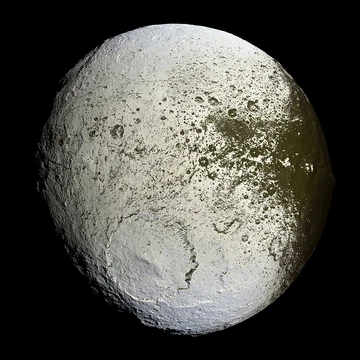
Crater counting estimates the age of a planetary surface by assuming that a fresh surface starts with zero impact craters. Craters then accumulate at a presumed known rate. By tallying craters of different sizes within a given area, scientists can calculate how long those craters have been building up, which reveals when the surface originally formed. This method was calibrated using radiometric ages from Moon samples brought back by the Luna and Apollo missions. It has been applied to estimate the ages of lava-covered regions on Mars and other planets, the giant mare areas on the Moon, and the times when icy surfaces on Jupiter and Saturn’s moons were flooded with new ice.
**Crater counting and secondary craters** The method relies on identifying independent craters—those formed directly by a primary impact. Secondary craters, or “secondaries,” are created when material ejected from a primary impact falls back to the surface hours, days, or even years later. These can be distinguished by their geometry: large primary craters often have rays of secondary craters. Secondaries may also have distinct shapes because the ejected material is slower and strikes at a lower angle than incoming asteroids. On Mars, the accuracy of age estimates for geologically young surfaces has been questioned due to abundant secondary craters. For instance, the impact that formed Zunil crater produced tens of thousands of secondaries, some over 1000 km away. If similar large impacts produce comparable numbers of secondaries, a crater-free area might simply have avoided being splattered by a rare large primary crater, rather than having experienced few small primary impacts. High-speed ejecta from independent craters can generate secondaries that resemble independent craters—appearing more circular and less cluttered than typical secondaries—thereby contaminating counts. This contamination leads some to question the method’s effectiveness.
**History** The first scientist to publish a study using crater counting as an age indicator was Estonian astronomer Ernst Öpik. He used the method to date the Moon’s Mare Imbrium at about 4.5 billion years, estimating the maria to be roughly 1000 years younger than the continents. The technique was later used by Gene Shoemaker and Robert Baldwin, and improved by Bill Hartman, whose dating of the lunar mare to about 3.6 billion years matched isot
- field
- Planetary science, geochronology
- known_for
- Estimating surface ages of planets and moons by counting impact craters
- key_developers
- Ernst Öpik, Gene Shoemaker, Robert Baldwin, Bill Hartman, Gerhard Neukum
- calibration_source
- Radiometric dating of lunar samples from Luna and Apollo missions
- applications
- Mars lava flows, lunar mares, icy moons of Jupiter and Saturn
Lore & Background
The earliest scientist to study and produce a paper using crater counting as an age indicator was Ernst Öpik, an Estonian astronomer and astrophysicist. He utilized the method to date the Moon's Mare Imbrium, though his actual work did not estimate the maria to be roughly 1000 years younger than the continents—that specific figure is a misattribution. In reality, the maria are younger than the lunar highlands by hundreds of millions to billions of years. The method was also utilized by Gene Shoemaker and Robert Baldwin, and further improved by Bill Hartman, whose work includes dating the Lunar Mare to approximately 3.6 billion years old.
Reader's Guide
Crater counting remains a fundamental tool for estimating surface ages on planetary bodies where direct samples are unavailable. Its calibration from lunar samples returned by Apollo and Luna missions provides a critical anchor. However, the method faces challenges: secondary craters formed by ejecta from primary impacts can contaminate counts, and shallow surface processes like aeolian deposition and erosion can alter crater morphology, making surfaces appear younger. Dense atmospheres can also impede accuracy by causing incoming meteors to burn up. Despite these issues, the method has been refined through approaches like buffered crater counting and computerized Crater Detection Algorithms, and it continues to be applied to Mars, the Moon, and icy moons of Jupiter and Saturn.
Did You Know?
- Secondary craters are formed by material excavated by a primary impact that falls back to the surface seconds or minutes later.
- The impact that created Zunil crater on Mars produced about a hundred secondary craters, some more than 1000 km from the primary impact.
- Earth is bombarded with approximately 100 tons of space dust, sand, and pebble particles every day, but most burns up in the atmosphere.
- The buffered crater counting method is considered more reliable in large areas than the basin method.
More in Impact craters 1-18
Spotted an error? Know more?
This is a living reference — every entry is fact-audited, and reader corrections feed straight into our audit queue. Suggest an edit · See this site's audit record