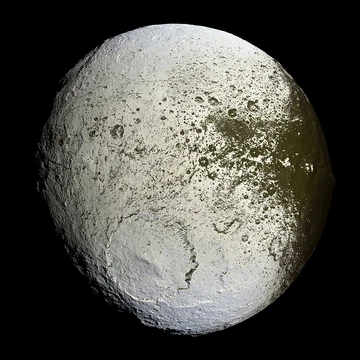
Multi-ringed basin
A massive impact crater with multiple concentric mountain rings.

Wikipedia / Wikimedia Commons
A multi-ringed basin is a type of impact crater characterized by multiple concentric topographic rings, resembling rings on a bull's-eye. Unlike simple bowl-shaped craters or peak ring craters, these basins can cover many thousands of square kilometres and are among the largest, oldest, rarest, and least understood impact structures.
- type
- Impact crater structure
- minimum_diameter
- About 180 miles (290 km)
- ring_diameter_ratio
- Approximately √2:1 (1.41 to 1)
- examples
- Mare Orientale (Moon), Anubis (Ganymede), Valhalla (Callisto), Evander (Dione), Caloris Basin (Mercury), Burney (Pluto), Chicxulub (Mexico)
- formation_consensus
- None; hypotheses include harmonic oscillations, brittle terrace faulting, and instantaneous ring formation via ductile subsurface flow
Lore & Background
Multi-ringed basins are formed by extremely large collisions, where the rebound of the surface after impact can obliterate any trace of the initial impact point. In contrast to more common peak ring craters, which have a single peak ring and a mountainous region surrounding the center, multi-ringed basins display multiple peak rings as further concentric circles. The ratio of diameters between adjacent rings approximates √2:1.
Reader's Guide
Multi-ringed basins are significant because they represent the largest and most energetic impact events known in the solar system. Their formation remains poorly understood, with no consensus among scientists. Research in 2016 on Mare Orientale on Earth's Moon proposed a model in which all rings form instantaneously: ductile subsurface rocks flow toward the basin center as the crust rebounds, causing concentric cracking and slippage that forms outer rings, while the unstable central peak collapses to form the inner ring. This model challenges the earlier 'slumping/megaterrace' hypothesis, which suggested rings formed later by fault subsidence. Examples across multiple planetary bodies—including the Moon, Jupiter's moons Ganymede and Callisto, Saturn's moon Dione, Mercury, Pluto, and the Chicxulub crater on Earth—show that multi-ringed basins are a widespread but rare phenomenon.
Did You Know?
- A multi-ringed basin may have an area of many thousands of square kilometres.
- The ratio of diameters between adjacent rings approximates √2:1 (about 1.41 to 1).
- Mare Orientale on Earth's Moon was created by an impactor perhaps 60 km in diameter traveling at 14 km/s.
- The Chicxulub crater in Mexico has a sufficient area to have been a multi-ringed basin.
More in Impact craters 1-18
Spotted an error? Know more?
This is a living reference — every entry is fact-audited, and reader corrections feed straight into our audit queue. Suggest an edit · See this site's audit record