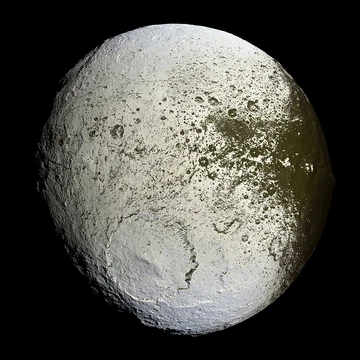
Ray system
Radial ejecta streaks from impact craters across the solar system.

Wikipedia / Wikimedia Commons
A ray system in planetary geology consists of radial streaks of fine ejecta thrown out during the formation of an impact crater, resembling spokes from a wheel's hub. These rays can extend for lengths up to several times the diameter of their originating crater and are often accompanied by small secondary craters formed by larger chunks of ejecta. Ray systems have been identified on the Moon, Earth (Kamil Crater), Mercury, and some moons of the outer planets, and more recently on Mars in infrared images taken from orbit by 2001 Mars Odyssey's thermal imager.
- field
- Planetary geology
- known_for
- Radial streaks of ejecta from impact craters
- identified_on
- Moon, Earth (Kamil Crater), Mercury, outer planet moons, Mars
- visible_in
- Visible and infrared wavelengths
Lore & Background
The physical nature of lunar rays has historically been a subject of speculation. Early hypotheses suggested they were deposits of salt from evaporated water, later thought to be volcanic ash or streaks of dust. After the impact origin of craters became accepted, Eugene Shoemaker suggested during the 1960s that the rays were the result of fragmented ejecta material.
Reader's Guide
Ray systems are significant for determining the relative age of impact craters, as over time various processes obliterate the rays. On non-atmosphered bodies such as the Moon, space weathering from cosmic rays and micrometeorites reduces the albedo differential between ejecta and underlying material. Rays can also be covered by lava flows or other impact craters. However, recent studies suggest that the relative brightness of a lunar ray system is not always a reliable age indicator, as the albedo also depends on the portion of iron oxide (FeO); low FeO results in brighter materials that retain their appearance longer. Thus material composition must be factored into albedo analysis for age determination. Notable lunar craters with pronounced ray systems include Aristarchus, Copernicus, Kepler, Tycho, and others on both the near and far sides of the Moon.
Did You Know?
- Ray systems have been identified on Earth at Kamil Crater.
- Thermal rays on Mars are especially apparent at night when slopes and shadows do not influence infrared energy.
- Most lateral transport of primary ejecta is limited to a few crater radii, but impacts like Copernicus and Tycho launched ejecta halfway around the Moon.
- North Ray and South Ray craters, each with a clear ray system, were observed from the ground by Apollo 16 astronauts in 1972.
More in Impact craters 1-18
Spotted an error? Know more?
This is a living reference — every entry is fact-audited, and reader corrections feed straight into our audit queue. Suggest an edit · See this site's audit record