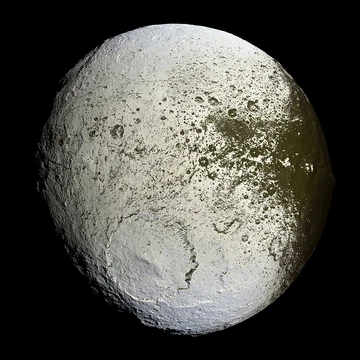
Permanently shadowed crater
Depressions in permanent darkness, preserving water ice and volatiles.

Wikipedia / Wikimedia Commons
In the Solar System, some craters contain points that never see sunlight. These are called permanently shadowed craters, or permanently shadowed regions (PSRs). By 2019, scientists had identified 324 such areas on the Moon, and they also exist on Mercury and Ceres.
These craters are found at high latitudes, close to a pole, on bodies with very small axial tilts. The Moon tilts about 1.5°, Mercury about 0.03°, and Ceres about 4°. On the Moon, permanent shadow can occur at latitudes as low as 58°. Roughly 50 of these regions lie between 58° and 65° latitude in each hemisphere. The total area of permanently shadowed lunar regions is around 31,000 square kilometers, with over half located in the southern hemisphere.
The interiors of these craters are extremely cold and stable. On the Moon, surface temperatures stay at or below 50 K (−223.2 °C), with estimates ranging from 25 to 70 K. For comparison, nitrogen boils at 77.09 K at atmospheric pressure. These low temperatures make the craters appealing sites for future infrared telescopes.
Permanently shadowed craters are valuable for space exploration because they can trap water ice, which could be turned into drinking water, breathable oxygen, or rocket fuel. Several craters show signs of water ice, including Rozhdestvenskiy and Cabeus on the Moon, and Juling on Ceres. Other volatiles, like mercury, can also be trapped. The LCROSS mission found native silver and gold in lunar permanently shadowed craters, likely delivered by electrostatic dust transport, and some inconclusive evidence for platinum. LCROSS data estimated gold at 0.52% and mercury at 0.39% of the soil mass. This high mercury level has been flagged as a possible health risk if water is extracted from these craters. The craters may also contain unusually high amounts of helium-3.
However, these regions pose challenges. Computer simulations suggest powerful solar storms could charge the soil near the lunar poles, possibly causing sparks that vaporize or melt the ground. The darkness limits rover navigation, the cryogenic regolith may be difficult to traverse, and communication can be interrupted. Nearby peaks of eternal light, which are almost constantly illuminated, could provide solar power. For instance, two peaks near Shackleton Crater are lit for about 94% of a lunar year.
A business case analysis suggests mining propellants from these crater
- Known lunar PSRs (as of 2019)
- 324
- Lunar axial tilt
- ~1.5°
- Mercury axial tilt
- 0.03°
- Ceres axial tilt
- ~4°
- Cumulative lunar PSR area
- ~31,000 km²
- Lunar PSR surface temperature range
- 25 to 70 K
Lore & Background
Permanently shadowed craters are found on the Moon, Mercury, and Ceres. On the Moon, they occur at latitudes as low as 58°, with about 50 such regions between 58° and 65° in each hemisphere. The southern hemisphere contains more than half of the total lunar PSR area. These craters have stable surface temperatures; on the Moon, temperatures hover at or below 50 K, with estimates ranging from 25 to 70 K. Computer simulations suggest that powerful solar storms can charge up the soil in these regions, possibly producing sparks that vaporize and melt the soil. Other challenges include dark environments that restrict rover perception, cryogenic regolith that may be difficult to traverse, and communication interruptions. Some craters have nearby peaks of eternal light, such as two peaks near Shackleton Crater that are illuminated about 94% of a lunar year, which could aid solar power generation.
Reader's Guide
Permanently shadowed craters are significant for space exploration and colonization because they preserve sources of water ice that can be converted into drinkable water, breathable oxygen, and rocket propellant. Several such craters show indications of water ice, including Rozhdestvenskiy and Cabeus on the Moon, and Juling on Ceres. Other volatiles, such as mercury, can also be trapped, and the LCROSS mission found native silver and gold in lunar PSRs, with gold estimated at 0.52% soil mass abundance and mercury at 0.39%. The high mercury abundance has been noted as a possible health hazard. The craters may also contain unusually high concentrations of helium-3. Their low temperatures make them desirable for future infrared telescopes. A 2020 business case analysis indicates that mining propellants in these craters could become profitable. In 2020, NASA assigned 'sensitive location' status to the Moon's PSRs to avoid contamination, with the SETI Institute managing planetary protection measures. Past missions include LCROSS (2009), which detected water in Cabeus; the Lyman Alpha Mapping Project (2012), which found a porous, powdery surface indicating water ice; and the Moon Mineralogy Mapper (2018), which confirmed water ice deposits near the south pole. The Lunar Flashlight (2022) failed to orbit due to debris blocking propellant lines, and the IM-2 mission (2025) landed on its side, preventing deployment of a hopper to explore Marston crater. The ShadowCam instrument has been aboard the Korea Pathfinder Lunar Orbiter since 2022, and planned missions include the International Lunar Observatory near Malapert and ESA's Moonraker mission using LiDAR.
Did You Know?
- As of 2019, there are 324 known permanently shadowed regions on the Moon.
- The LCROSS mission found native silver and gold in permanently shadowed lunar craters, with gold estimated at 0.52% soil mass abundance.
- On the Moon, permanently shadowed regions have stable surface temperatures ranging from 25 to 70 K.
- In 2020, NASA assigned 'sensitive location' status to the Moon's permanently shadowed regions to avoid contamination.
More in Impact craters 1-18
Spotted an error? Know more?
This is a living reference — every entry is fact-audited, and reader corrections feed straight into our audit queue. Suggest an edit · See this site's audit record