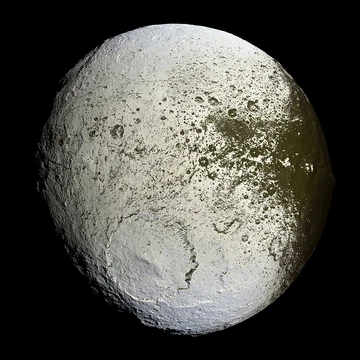
Peak ring
A complex crater with a ring instead of a central peak.

Wikipedia / Wikimedia Commons
A peak ring crater is a type of complex impact crater characterized by a roughly circular ring or plateau surrounding the crater's center, rather than a central peak. The crater rim lies farther outward. This structure is distinct from multi-ringed basins and central-peak craters.
- type
- Impact crater morphology
- distinctive_feature
- Roughly circular ring or plateau around center, no central peak
- known_for
- Chicxulub crater, Earth's only intact peak ring structure
- formation_process
- Formed after central peak stage, dependent on crater diameter and planetary gravity
- alternative_hypothesis
- Over-high central peak may collapse into peak ring
Lore & Background
Peak ring craters are a type of complex crater, differing from multi-ringed basins or central-peak craters. Instead of a central peak, a roughly circular ring or plateau, possibly discontinuous, surrounds the crater's center, with the crater rim farther out. The rings form by different processes, and inner rings may not form by the same processes as outer rings. It has long been viewed that peak rings form in the stage subsequent to central peak formation, dependent on crater diameter and planetary gravity. The central peaks of craters are believed to originate from hydrodynamic flow of material lifted by inward-collapsing crater walls, while impact-shattered rock debris is briefly turned to fluid by strong vibrations during crater formation. For the Chicxulub crater, the peak-ring structure was probably formed as inward-collapsing material struck the over-steepened central peak, creating a hydraulic jump at the peak ring's location. Another hypothesis suggests an over-high central peak collapsed into the peak ring.
Reader's Guide
Peak ring craters represent a distinct morphological class in impact cratering, bridging the gap between central-peak craters and multi-ringed basins. Their formation is tied to the dynamics of crater collapse, where the transition from central peak to peak ring depends on crater diameter and planetary gravity. The Chicxulub crater on Earth is the only known intact peak ring structure, making it a critical natural laboratory for studying these features. The formation process remains debated: one model proposes that inward-collapsing material strikes an over-steepened central peak, generating a hydraulic jump that forms the ring; another suggests that an initially over-high central peak collapses into the ring. Understanding peak rings provides insight into the mechanics of large impacts, including those that have shaped planetary surfaces and influenced Earth's history. The Carswell crater in Saskatchewan, Canada, may also be an eroded peak ring crater, offering additional evidence. These structures help scientists reconstruct impact events and their effects on planetary crusts.
Did You Know?
- A peak ring crater has a roughly circular ring or plateau around its center, not a central peak.
- Chicxulub crater is Earth's only crater with an intact peak ring structure.
- The Carswell crater in Saskatchewan, Canada, may be an eroded peak ring crater.
- One hypothesis suggests peak rings form when an over-high central peak collapses into the ring.
More in Impact craters 1-18
Spotted an error? Know more?
This is a living reference — every entry is fact-audited, and reader corrections feed straight into our audit queue. Suggest an edit · See this site's audit record