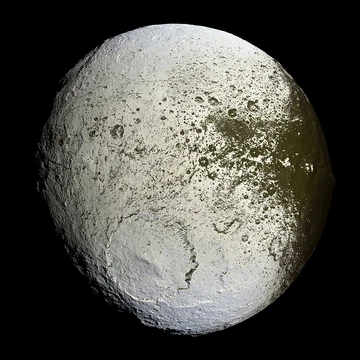
Secondary crater
Secondary craters form from ejecta of larger primary impacts.

Wikipedia / Wikimedia Commons
Secondary craters are impact craters formed by the ejecta thrown out of a larger primary crater. They often appear as radial chains, clusters, or rays surrounding the primary crater. Their study became prominent in the mid-twentieth century when researchers realized that secondary craters contaminated crater statistics used to estimate the ages of planetary surfaces.
- field
- Planetary geology, impact cratering
- known_for
- Formation from primary crater ejecta; contamination of crater age-dating statistics
- occurrence
- Common on rocky bodies with no or thin atmospheres (e.g., Moon, Mars); rare on bodies with thick atmospheres (e.g., Earth, Venus)
Lore & Background
Secondary craters form when material expelled from a primary impact crater is driven back to the surface by sufficient gravitational acceleration and at a velocity high enough to create a new crater. On bodies with atmospheres, such as Earth, Venus, or Titan, it is more difficult for ejected material to retain the necessary velocity. Bodies with high resurfacing rates, like Io, also do not record secondary craters.
Self-secondary craters are a subset that form when ejected material lands within the primary crater itself, causing controversy in age-dating studies. An observed feature on Tycho has been interpreted as a self-secondary crater morphology known as palimpsests.
Secondary craters can appear as small singular craters, chains, or clusters. Their size is limited to less than 5% of the parent primary crater's diameter. Those closer to the primary tend to be more elliptical and shallower, while more distant secondaries appear more circular and often form clusters.
Reader's Guide
Secondary craters are significant because they complicate the use of crater counts for dating planetary surfaces. Scientists rely on three key assumptions for age estimation: craters occur as independent events, the size frequency distribution of primary craters is known, and the cratering rate over time is known. Secondary craters violate the independence assumption, contaminating small-crater statistics and leading to false precision in age constraints. This contamination is especially problematic when using small craters (diameter ≤1 km) to date small surface areas. Distinguishing primary from secondary craters can be difficult, particularly when projectiles break apart in an atmosphere before impact, as on Earth. The study of secondary craters has thus forced researchers to refine their methods for interpreting crater records across the Solar System.
Did You Know?
- Secondary craters sometimes form radial crater chains or clusters around primary craters.
- Self-secondary craters form when ejecta lands within the primary crater itself, causing controversy in age-dating studies.
- Secondary craters have a maximum diameter of less than 5% of their parent primary crater.
- A field of secondary impact craters in Wyoming and Nebraska is believed to have been formed by ejecta from a primary impact around 280 million years ago.
More in Impact craters 1-18
Spotted an error? Know more?
This is a living reference — every entry is fact-audited, and reader corrections feed straight into our audit queue. Suggest an edit · See this site's audit record